
Children of Zeus
Mythical whispers of the inner wounded.
A performance as Living Exhibition by Robbeduz and Valentina Gal
OPEN FOR BOOKINGS 2027-2028
Children of Zeus is a living exhibition and an intuitive journey. This living exhibition questions our relationship with nature, the body, and spirituality within today's technological lifestyle.
The premiere of Children of Zeus took place 12th of May 2026 at Bellevue, Amsterdam.
Two queer Children are discovering the healing power of water within a mythical swamp. Here, they manifest their freedom, free from the oppressive patriarchal powers of Zeus. Old paradigms fade, but not without obstacles. Through their transformative powers, the children will create a fluid world in which they attempt to restore the balance between humanity and nature. The knowledge of their ancestors is found here in breath and rhythm, and is discovered through the body, water, and installation. The friction between forgotten histories and the rise of technological humanity forms a key starting point of their journey into this mythical swamp.
Dancemaker Robbeduz (them/their) and visual artist Valentina Gal (she/her) jointly create an installation consisting of water and sculptures. The collaboration arose from a shared fascination with water, which serves as a metaphor for fluidity and healing powers. Based on this installation, they explore how a sustainable relationship with nature can be created, which includes using natural materials and recycling. Children of Zeus builds on the makers' previous works, Cyborg DNA (Robbeduz & Lux Nautilus, 2023) and Troubled Waters (Gal, 2024). Objects from these earlier works are sustainably rediscovered within this research, aiming for a tangible transmission and contemporary translation of queer ecology.

What You See Festival - Karin Jonkers
Queer ecology offers an alternative framework centered on non-binary fluidity. The lived embodiment of queer ecology provides a lens through which this artistic team shares liberation movements in various ways. Seeking liberation from Western patterns and oppression, maker and performer Robbeduz, explores their Thai heritage more deeply and connects this to the creative process for both installation and performance. In Thailand and Buddhism, the lotus symbolizes purity and spiritual awakening. This journey embodies all the emotional aspects encountered during such a profound transformation: from mud to the beauty of the lotus.
“Listen to the forgotten melodies,
wounded children follow the wind
trusting the rhythm of nature to find healing and transformation.”
-Children of Zeus
"From the muddy and even blood-colored water of the swamp, the silver splendor and beauty of the lotus flowers grow."
"In the dimly lit surroundings of the pond, the performers find their healing dreamland."
"Choreographer and performer Robbeduz creates a delicately refined performance in this idyllic work of visual art."
"What we see is a fascinating dance play, of a stylized dynamism."
"We hear paradise-like sounds of birds, of string instruments and very lightly touched percussion instruments, such as singing bowls."
"Uit de modder en zelfs met bloed gekleurde water van het moeras groeien de zilveren pracht en schoonheid van de lotusbloemen."
"In de halfduistere entourage van de vijver vinden de performers hun genezend droomland."
"Choreograaf en performer Robbeduz creëert in dit idyllische beeldende kunstwerk een ragfijne uitvoering."
"Het is een fascinerend dansspel dat we zien, van een gestileerde dynamiek."
“We horen paradijsachtige klanken van vogels, van snaar- en heel licht aangeraakte slaginstrumenten, zoals klankschalen."
-Kester Freriks, Theaterkrant- https://www.theaterkrant.nl/recensie/children-of-zeus/robbeduz-valentina-gal/
To bring more awareness surrounding their researched, after-talks are often held. Here able to see an after-talk after the premiere of Children of Zeus May 2026. “After the performance, there will be a post-show talk in the speakeasy with Agathe P. Jeanty, Robbeduz (Robin Nimanong), and Valentina Gal. The conversation will be moderated by Agatha and will focus on the POC perspectives and experiences during the research for and creation of Children of Zeus, and how these are now reflected in the performance.”
See here: https://vimeo.com/1221104604?share=copy&fl=sv&fe=ci
We have also archived, through studio and rehearsal visits, while being able to talk with the full interdisciplinary team of Children of Zeus. Because of the focus on POC and queer perspectives within this research, we wanted to archive respectably towards the sensitive topics, with a holistic awareness. Zahira Mous helped us during our process and nourished the process towards the premiere and shows.
Text by: Zahira Mous
A mystical and multi-layered living exhibition and performance Children of Zeus, mythical whispers of the inner wounded premiered on May 12th at the Bellevue Theater in Amsterdam. This performance lives at the crossroads of a live arts installation and interdisciplinary theater. Dance maker and performer Robbeduz (Robin Nimanong) and visual artist Valentina Gal have co-created a mystical ecosystem in which sophisticated scenography, physical theater and ballroom meet, embedded in queer feminism.
This multilayered dimension leaves one contemplating their own existence. The work questions oppressive systems and frameworks that impose restrictions and shine light of west and east to contrast. Children of Zeus reminds us that we can create our own reality. That we can express ourselves in ways that feel natural to us. And that perhaps the way to break free from harmful systems is to remember and celebrate one’s essence. This living exhibition invites one to slow down and travel inward.
See more here: https://www.nimanong.com/children-of-zeus/zeus-archive
Also interviews are archived and published for earlier works like Bodyscan 223, about algorithms, bias and discrimination caused by western technology. See here: https://vimeo.com/1218650306?fl=pl&fe=sh
Credits
Artiest (initiator), dansmaker, productie
Robbeduz (Robin Nimanong)
Instagram: https://www.instagram.com/robbeduz/
Website: www.nimanong.com & DOX: https://wijzijndox.nl/producties/agenda/children-of-zeus
Scenografie en sculpturen, beeldend kunstenaar & co-creator
Valentina Gal
Website: https://www.valentinagal.com
Uitvoerend dansers
Qiqi (Qiyun Zheng), Fleur van der Schaaf, Robbeduz & Jieon Ko
Dramaturgy
Suzy Blok & Sophie Cohlen
Coaching
Hildegard Draaijer (DOX)
Co-production
Dox Utrecht
cCreative production support & dramaturgy
Athina Liakopoulou
Movement Research & Ballroom Artist
Shiva Mugler
Music
Guenter Raler, Nils Davidse, Robbeduz
Costume
Reconstruct & Eva Marie-Louise
Light Design
David Vermeulen
Ecological decoration and research
Oliver Toxopeus and Ache Charlène Wang
Residency 2025 (work in progress)
Huis Conny Janssen Danst, Pleintheater, Hollandse Luchten,
What You See Festival 2025 (Theater de Kikker), RightAboutNow, Magnezy
Video’s online
Filmed by MMMViideo (instagram personal: tremattia)
Artistic research
Dovilee Krutulytė & Jordan Achiano
Supported by: Cultuurfonds, Stimuleringsfonds, Fonds 21, Diorapthe, Fonds Podiumkunsten (De nieuwe makers regeling with DOX Utrecht), Gemeente Utrecht, Norma.
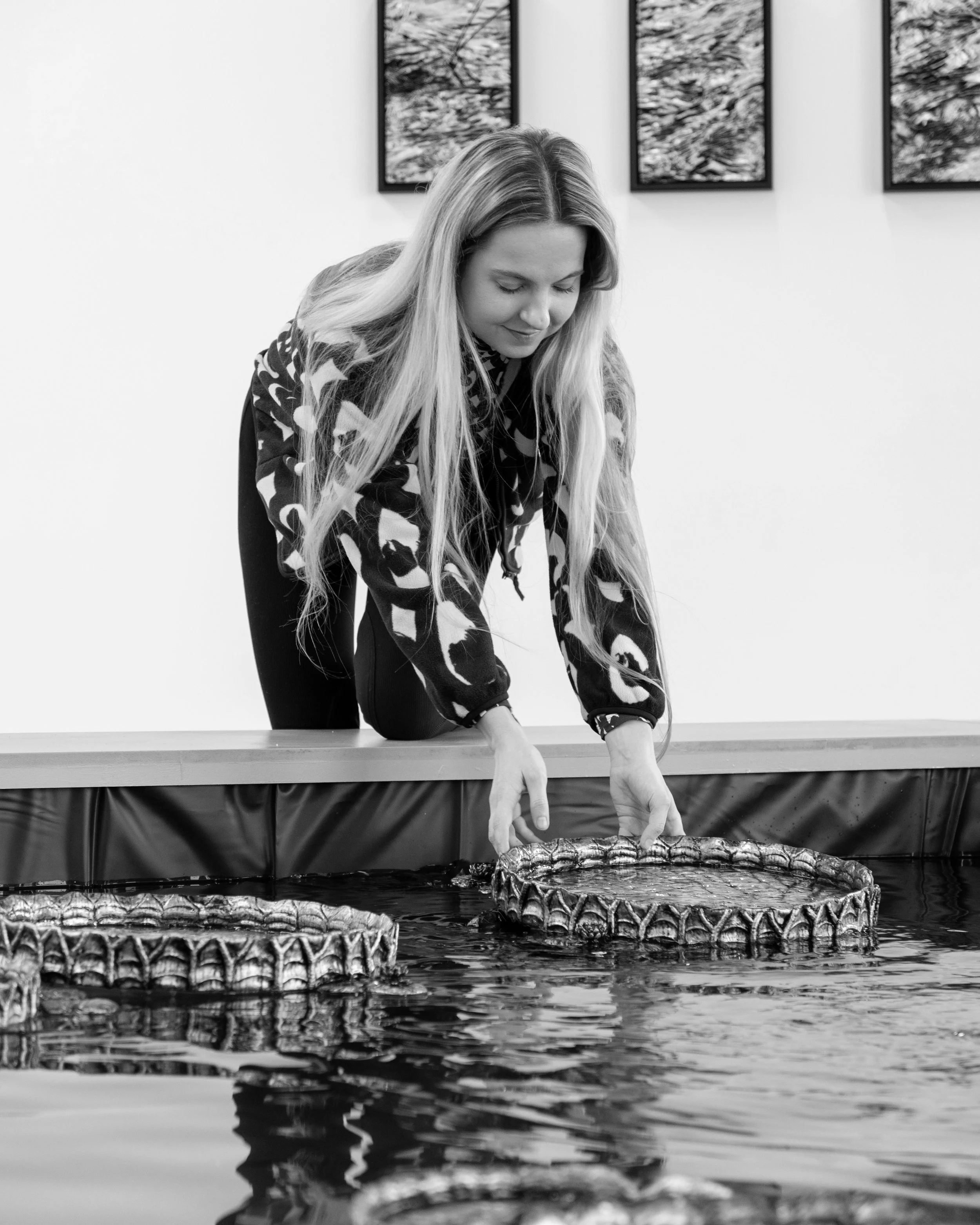
Valentina Gal (1994) is a Dutch multidisciplinary artist whose work moves along the threshold between physical reality and the worlds we build to survive it. She has developed a practice centred on immersive video installation, sculpture, and sensory experience.
Her approach is deeply anthropological: she embeds herself in communities that exist at the edges of mainstream visibility, drawn to the places where people reinvent themselves through digital identity, avatar, and online persona. From professional dog shows and ASMR culture to VTubers, furry fandom, and wellness spaces, she traces how people use image, voice, and presence to escape, transform, or tenderly remake themselves. From these investigations she builds total environments, works that open like cracks in reality, where the ordinary and the digitally strange dissolve into each other. Alongside video and sound, she works with 3D-printed objects, light, and scent, often choosing bio-based materials that keep the ecological footprint of the work in mind.
Her work is a quiet insistence that the strange is sacred, and that the worlds we imagine ourselves into are as real as any other.

Oliver Toxopeus is an artist, engineer and architecture student focused on integrating queer ecology into every discipline imaginable. They are researching trans-species collaborative design and have applied their research to Children of Zeus by growing decor pieces together with more-than-human colleagues.
Oliver has been collaborating with Ache. Ache Wang, a French designer based in the Netherlands. Together they have been designing with Chia seeds for Children of Zeus.
Sophie Cohlen (1998) is a Dutch dramaturg, curator, and moderator specializing in dance. She studied Theatre Studies and International Dramaturgy at the University of Amsterdam. She currently curates the Theatre & Dance program at We Are Public, moderates context programs at a.o. Het Nationale Theater and International Theatre Amsterdam, and works as a dramaturg with emerging dance makers. Her work focuses on experimentation, social and political themes, and the intersection between performing arts and nightlife culture.

Agatha Prieto Jeanty (she/her) is a multidisciplinary visual artist and design researcher working between the West and the Caribbean. She reconfigures realities through a diasporic imagination and a travelling stance. Rooted in community, she explores decolonising practices through embodied experience and a feminine gaze. Influenced by Afrofuturism, her work weaves contemporary narratives with ancestral wisdom to challenge dominant histories. For this project, she will be moderating and being a part of the conversation for the after-talk that will take place on the 12th May.'


Zahira Mous (she/they) is a dance theater maker, performer, writer, and guide of collective processes through movement and magic. For Children of Zeus, Zahira is involved as an archivist, putting the work (part process/part performance) in writing in contexts of decolonization, queer theory, and feminine dramaturgy.

Suzy Blok (Dutch/Argentinean, born in Colombia) is a mentor, advisor, and curator in dance and performance. She is currently mentor at Artists Circle, coach for various emerging artists and advisor at Funds for Performing Arts and Utrecht. She’s co-founder and board member of the Moving Futures festival and network.

Working together with Oliver Toxopeus
Ache Charlène Wang (they/them) is a transdisciplinary artist, designer-researcher from the Sino-diaspora. Born in Paris in 1999, raised within the multiplicity of languages and cultural crossings, their practice unfolds a dialogue of decolonial narratives, translating gestures, materials, and meanings. Specialised in knitting programming and metal working : from the weight of steel to the fluid tension of yarn, Ache builds narratives that interlace craft and migration, memory and machinery.
Shiva Mugler is a performer, dancer, and voguer working in the international ballroom and queer club scene. As a "Legendary" member of the House of Miyake-Mugler, she brings a powerful physical and aesthetic signature that fuses performance, attitude, and queer empowerment. In addition to her work as a performer, she is active as a coach and mentor for young artists and dancers developing within contemporary movement languages. She teaches, floor siren, runway and contemporary classes and has been coaching Nimanong within Ballroom and their work already for several projects. Projects with Robin: Bimbo Manifesto, Children of Zeus
Guenter Råler is a music producer and sound artist based in Rotterdam. By shaping textures and atmospheres, they create evocative and emotionally-charged musical pieces. For this project they explored different sonic palettes around the themes of nature, water, healing and transformation, bringing together electronic and acoutisc sounds that would embody the narrative and visual nature of the performance.
Nils Davidse graduated with a bachelor degree for piano at the conservatory of Utrecht and during his studies he fell immediately in love with electronic instruments. After a long time of performing music and being involved in the art scene he started a master research at the Institute of Sonology at the Royal Conservatory of The Hague, successfully graduating in 2023.
Music Credit
Canoe – Taylor Dupree - Remix Robbeduz
Spoken Text voice: Maya Link – written by Robbeduz
Bells, Piano to Glitch track - Nils Davidse
Garden music, Yon Eta - Next Orbit & Valentina Gal
Knife music – Guenter Råler
Spoken text voice: Som Schouten – written by Robbeduz, supported by performers and translated to Thai by Som Schouten
Remix (small adaptations) Chant Pearson Sound edit and mastered – Guenter Råler
Storm and Glitchy birds track – Robbeduz
Singing by Robbeduz
Spear song – Blue Heron – Milan W.
Sounds – Nils Davidse
No hoist Total Internal Reflection - Raii point of view ASL – Robbeduz Minor Remix
Frequency and drumm – Robbedyz and mastered by Guenter Råler
Underwater – Guenter Råler & Nils Davidse
Mastered by Guenter Råler

Zeus Archive
By Rebecca Douglas:
The hall (theatre) of De Nijverheid (10th of October 2026) has, at least for the next two hours, been transformed into an otherworldly swamp; a liquid temple that will play host to an embodied investigation of nature, spirituality, and technology. Ushered in from heavy October rain, the audience enters a different watery landscape inhabited by two beings who, eyes closed, sway meditatively to a gently pulsing soundscape. Just under their ankles, the space is reflected in a shallow pool of water, creating the impression of a world that stretches deep below. The illusion is striking, inviting one to truly lean into the mythological journey that is about to unfold.
This visually rich tableau is the collaborative project of choreographer and performer ROBBEDUZ (aka Robin Nimanong) and visual artist Valentina Gal. Children of Zeus - which is described as a living exhibition - is the outcome of months of collective research, and it is storytelling at its most decadent. Rich movement motifs which draw from lexicons of voguing, contemporary performance, and more theatrical mimicary, blend with a hypnotic setting constructed from glossy plants that protrude from the water, and lotus flowers that float atop. Where these elements converge is within ROBBEDUZ’s own identity, pulling from the spirituality of their Thai heritage and queer identity. Through an invocation of traditional Greek mythology, Children of Zeus is the outwards expression of lived experience combined with creative worldbuilding. And, like most good myths, it grabs my attentive curiosity throughout.
My interest in the finalised version of Children of Zeus was ignited following my interview with another writer who had witnessed a more embryonic version of the performance at What You See Festival 2025, where it was shared as a work-in-progress. “You might not know the references being made, nor what they mean, but you’re invited to look, whether you understand it or not,” dancer and writer Sid Yeo reflected. This ability to invite the audience into themes that can seem incredibly personal or specific to the choreographer is crucial; translation, empathy, and communication, without watering down the elements that make the performance so urgent. The lights might be low, the room cold, but the welcome is warm, and ROBBEDUZ and Gal’s research carves space for personal connection.
The two beings - enacted by dancers Fleur van der Schaaf and Qiqi (aka Qiyun Zheng) - gradually begin to move more freely, their feet sending ripples through the water with subsequent splashes and slops. They let their fingers slip down to caress the surface. As their movement grows in power and intensity, water becomes a more active presence. It drenches their clothing and highlights their movement with great arches of droplets. It moves in such a way that it is no longer distinguishable from flesh. Water is the essential element in this installation. It is metaphorically rich, offering the possibility of fluidity in identity, and a slippage between reality and myth. In two separate moments, the colour of the water is changed by (beetroot and rice) powder dispersed from small ritualistic bowls, transforming the swamp from white to red. Water transforms and is transformative.
Beyond this liquid metaphor, I find myself equally interested in the shifting relationship between these curious characters. At times, their proximity is approached with intimacy and care; inquisitive gazes and gentle touches. In another more theatrical moment, van der Schaaf holds a blade to the heart of Qiqi, forcing them backwards in an unexpected display of violence. My understanding is that these characters are unfixed. Whilst there is no need for narrative linearity, I find myself searching for some familiar references when, at times, the characterisation becomes too discordant.
Children of Zeus is a work of two distinct halves, the second of which is initiated by the entrance of ROBBEDUZ’s character. They stalk the space, staring past the audience and holding themselves with an unfaltering confidence. They don furs and tight pants - part club kid, part warrior. The arresting persona is amplified when they begin to seamlessly integrate voguing; their stride becomes a catwalk during which they perform with precision and sensuality. The mythical pool becomes a site for contemporary expression; an arena of self actualisation.
Eventually, this first character sheds - literally. ROBBEDUZ disrobes, leaving nothing but lightly coloured tights and a loose fitting shirt. The catwalk is succeeded by a more creature-like embodiment. They walk on hands and feet, or prowl through the now-red water, spear in hand. Owing to the mythical soundscape and series props that seem to resemble fantasy weaponry, I consider how some aesthetics might have been drawn from digital gameplay; narrative videogames in which the player is invited to choose a new skin (character), and indulge in an online realm that poses the possibility to enact a new identity. I am reminded of Legacy Russell’s seminal text Glitch Feminism in which she suggests how the production and enactment of “the digital skins we develop and don online, help us understand who we are with greater nuance. Thus, we use glitch as a vehicle to rethink our physical selves.” I imagine how each performer might see the stage as an experimental playground in which they can enact a series of personas, each one attuning them to a different aspect of their multilayered selves.
Grasping the sides of an engorged and flesh-like lotus flower, ROBBEDUZ slowly descends to the ground, encasing themself in its membrane like a cocoon, indicating the end of this more theatrical activation of the space. Yet, Valentina explains to the audience, the living exhibition continues and we are welcome to move in and out of the space to observe this shifting constellation of bodies and sculptures. Our performers fill the watery stage once again, interacting with their surroundings in a slower, exploratory manner; balancing lotus flowers on their body, or encasing themselves in large, semi-translucent skins. In this moment of calm, the audience is offered the chance to digest, rest, and consider the impact of the journey we have witnessed. Transformation is the lasting imprint, I think as I watch these now naked forms take on different shapes and stances. From human, to plant, to God, to technobeing, this collaborative worldbuilding practice encourages an optimistic outlook on a fluid existence. An outlook that allows us to break free from the confines of Western epistemologies, and work towards a liquid and liberated future.
-By Rebecca Douglas, on the performance and Living Exhibition at Nijverheid 10th of October 2026, as part of Utrecht Queer Culture Festival.
A written archive, impressions and reflection by Zahira Mous.
“Because of the focus on POC and queer perspectives within this research, we wanted to archive respectably towards the sensitive topics, with an holistic awareness. Thank you Zahira Mous for your guidance, inspiration and very accurate observations and gathering of information. This helped us during our process and nourished the premiere and shows to come.”
-Robin Nimanong
A mystical and multi-layered living exhibition and performance
Children of Zeus, mythical whispers of the inner wounded premiered on May 12th at the Bellevue Theater in Amsterdam. This performance lives at the crossroads of a live arts installation and interdisciplinary theater. Dance maker and performer Robbeduz (Robin Nimanong) and visual artist Valentina Gal have co-created a mystical ecosystem in which sophisticated scenography, physical theater and ballroom meet, embedded in queer feminism. This multilayered dimension leaves one contemplating their own existence.
While the audience enters, two queer performers, Qiqi (Qiyun Zheng) and Fleur van der Schaaf, are moving their bodies in ways that resemble plants that sit at the bottom of the sea. They make movements with their torso and limbs as if being moved by the waves of the water. The performers are standing in a large water basin of ten centimeters depth, in which silver lotus petals are placed. Metal looking lotus flowers rise from the corners of this mythical ‘swamp.
’The lotus flowers are a reference to Buddhism and a connection to Robbeduz’s Thai background, symbolizing purity and spiritual awakening. In a previous conversation, Robbeduz shared that Valentina and them have a shared fascination for water and natural elements. And that the use of water is a metaphor for non-binary fluidity. They call this ‘queer ecology. ’A dim light shines on the water, which creates reflections of rippling water on the walls besides the audience. The audience sits 270° around the swamp.
In my impression, the performance is presented in three acts. In the first act, Qiqi and Fleur show the vulnerabilities of Being, of becoming a ‘lotus dancer’ and a ‘sword dancer, ’ engaging with varying realities. The dancers embody Aphrodite and Ares archetypes of love and war.
The performers carve out a new world that cuts through time and space with a sword. Qiqi spreads a white substance (rice flour) into the water, through which Fleur sweeps the sword. They move the color around the water and create various lines that look like whirly pathways. This section transitions into the second act, in which Qiqi dances vogue, a movement style from ballroom. They are living and embodying a new, queer world, on their own terms.
As Robbeduz appears, the other performers take lotus bowls from which they throw a red substance (beetroot powder) into the air and the water. It becomes a blood swamp. The third act starts. Robbeduz appears as Zeus, moving their arms above their head to create thunder while lights flicker. A transformation takes place, in which Zeus dies, an animalistic form arises, which turns into a new human; playful and free.
In addition to the movement, choreography and subtle qualities of how this piece is performed, other ‘characters’ aid the multi-layered qualities of this work, such as the musical compositions that show electronic work, slow sweeping meditative sounds, and Thai influences woven together with well written poetic works that were pre-recorded and utilized in the performance atstrategic moments. An entire ecosystem evolves, in which the production elements dance a mystical dance together. Waving and weaving together.
The work questions oppressive systems and frameworks that impose restrictions and shine light of west and east to contrast. Children of Zeus reminds us that we can create our own reality. That we can express ourselves in ways that feel natural to us. And that perhaps the way to break free from harmful systems is to remember and celebrate one’s essence. This living exhibition invites one to slow down and travel inward.
-Text by: Zahira Mous
“Silver forms like leaves in a forest, lotus blooms drifting on the surface, the slow reddening of something that was once still. A world built from myth and organic matter, from the wreckage of old hierarchies and the quiet persistence of what grows anyway. A living installation and performance, shaped by water and myth, by body and breath.”
-Theaterkrant, Kester Freriks.